
A master carton of six glass canisters arrives at a U.S. distribution center. The receiving team needs to identify the item and count six sellable units. The unloading crew needs to know the contents can break. The consumer who buys one canister may never see the master carton. Each person needs different information, and putting all of it on the shipping case can leave a required mark on a box that gets discarded.
Carton markings are the words, numbers, barcodes, and symbols printed or applied to a shipping case. Some identify the shipment, some tell a handler what to do, and some are required by law for a particular product or shipment. To approve carton artwork, determine who needs each mark, which packaging layer reaches that person, and who can verify the information before print.

What belongs on a master carton?
| Mark | What it tells the reader | What determines its use |
|---|---|---|
| Shipping mark | Which order, item, destination, and quantity the case belongs to | Purchase order and buyer’s routing or packing guide |
| Case barcode | Which case configuration the warehouse is receiving | Buyer’s item setup, case pack, and barcode specification |
| Handling symbol | How to lift, orient, protect, or store the packed case | Product sensitivity, pack design, and customer instructions |
| Country-of-origin marking | Where the imported article originates | U.S. customs rules, the article, and how it reaches the ultimate purchaser |
| Dangerous goods mark or label | Which transport hazard or shipping provision applies | Material classification, quantity, packaging, and transport mode |
| Box maker’s certificate (BMC) | Construction and strength information about the corrugated box | Box specification and applicable shipping or customer requirements |
A drawing can contain several of these marks on the same panel. Approve each against its own source. The buyer can confirm the item number and case pack. The corrugated supplier can confirm the BMC against the board ordered. Read GreenDot’s guide to BMC marks for the meaning of the strength and size information inside the stamp.
Front marks and side marks on a shipping carton
Suppliers often call the main identification panel the front mark and the supporting product details the side mark. These are useful terms for describing artwork to a factory. The buyer’s current specification determines which panels carry which fields, including any information that must repeat on adjacent sides.
Here is an illustrative shipping mark for a case of glass canisters. The values show how to write a proof, rather than serving as retailer specifications.
| Front mark | Side mark |
|---|---|
| Ship to: Denver DC | Item: GC-750-CLR |
| PO: 45821 | Description: 750 mL clear glass canister |
| Buyer item: 104782 | Case pack: 6 each |
| Carton 7 of 24 | Gross weight: 4.8 kg |
| Outside dimensions (L × W × H): 38 × 26 × 22 cm |
“Carton 7 of 24” identifies one case in a shipment. “6 each” tells receiving how many sellable units to book. If each canister ships in its own retail box, “6 each” still describes the master case. Gross weight includes the product, retail packs, dividers, and shipping carton. Check it against a packed production sample.
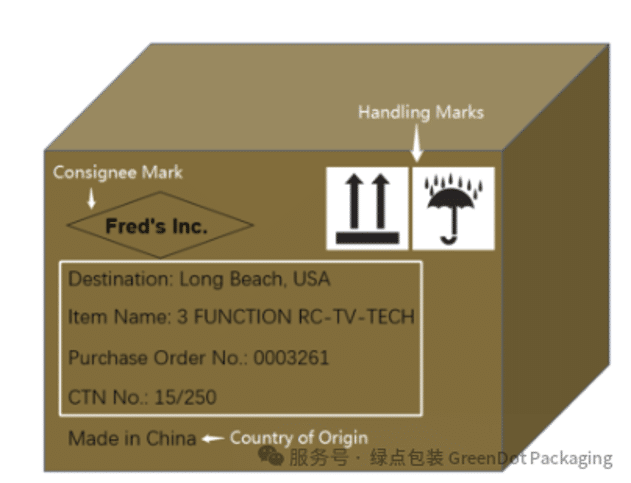
What should be preprinted? The item description and case pack can be preprinted if the same board serves one configuration. A PO number, carton sequence, lot, or destination may change with every run. Reserve a clear area for those fields and agree on who applies them. A supplier producing 2,000 blanks for several orders should be able to use the blanks without covering an obsolete PO.
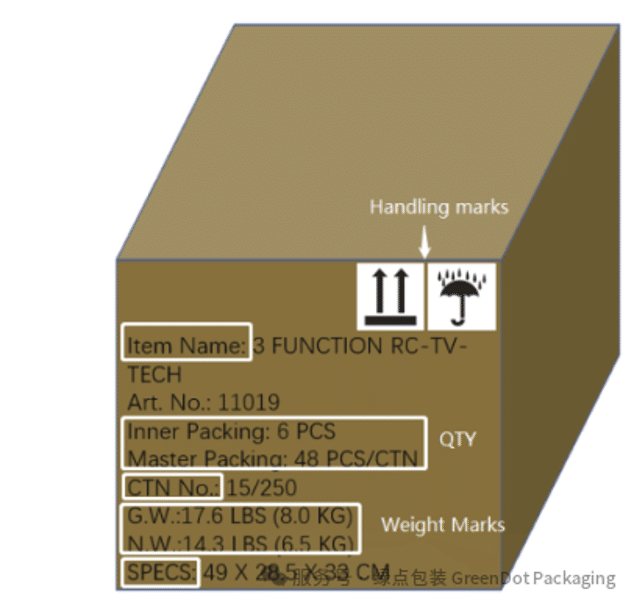
What do the handling symbols mean?
| Symbol | Meaning | What to check on the packed carton |
|---|---|---|
| Wineglass | Fragile contents. Handle with care. | The symbol is visible when the case is picked. The inserts actually restrain and protect the glass. |
| Umbrella with rain | Keep dry. Protect the case from moisture. | The instruction makes sense for the board, contents, and storage conditions. |
| Two upward arrows | Keep this side up. | The arrows point toward the intended top after erection and closure. |
| Stacking limit by number | Limit the stack to the indicated number of packages. | The stated limit matches the approved pack, load, and storage conditions. |
A wineglass tells the handler something about the contents. It says nothing about the drop performance of the finished pack. Likewise, a stack limit copied from a smaller SKU can overstate the capacity of a larger carton made from the same board. Approve handling instructions against the packed product. For more pictograms and production artwork, see Common International Packaging Symbols and Their Meanings and the free vector packaging symbols download.
Which regulatory markings belong on a U.S.-bound carton?
Country of origin follows the imported article
For most imported articles, U.S. law requires a conspicuous, legible marking that gives the ultimate purchaser the English name of the country of origin, subject to exceptions. A container marking can satisfy the requirement in qualifying circumstances when the container reasonably indicates the article’s origin and reaches the ultimate purchaser. 19 CFR Part 134 · CBP container-marking example
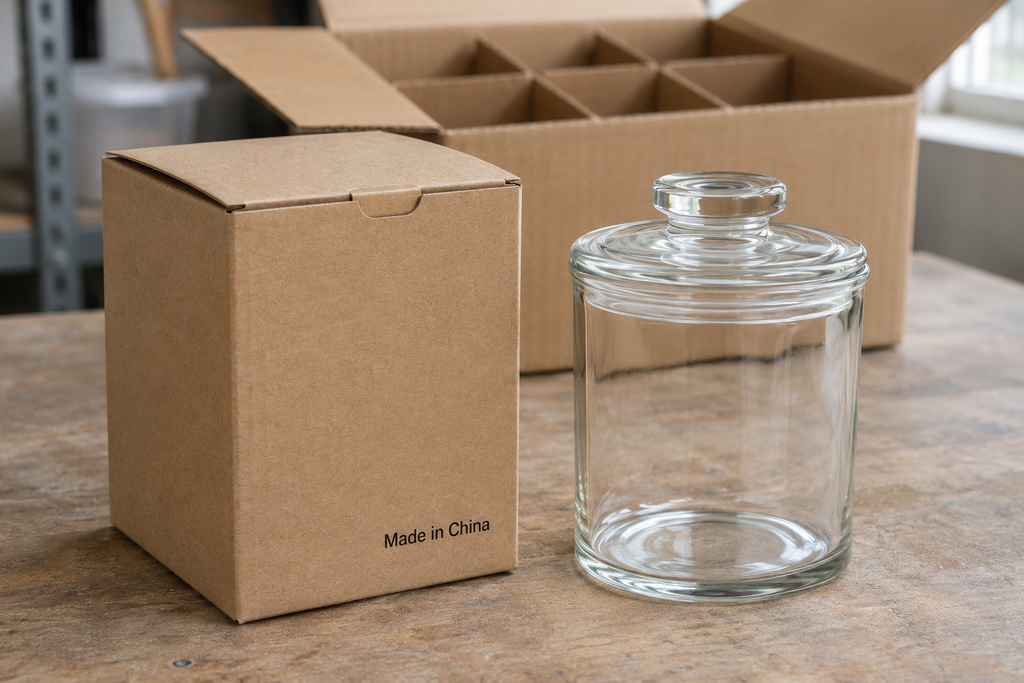
Return to the canisters. If a distribution center discards the six-pack shipper and the store sells the units individually, the consumer never sees “Made in China” on the shipper. Have the importer confirm the actual origin and whether the article itself must be marked or its individual retail packaging qualifies. The factory address, port of loading, and country where the corrugated box was made answer different questions.
Dangerous goods symbols depend on what is being shipped
A hazard-class label identifies a transport hazard. For example, a red Class 3 label with a flame identifies a flammable liquid. A limited quantity mark is the square-on-point with dark top and bottom portions used for qualifying shipments. Its application depends on the applicable transport provisions. A small bottle or a small carton alone does not establish eligibility. DOT hazard labels · Limited quantity marking
Even familiar handling arrows can have regulatory significance. For applicable combination packages containing liquid hazardous materials, U.S. rules specify orientation marks on two opposite vertical sides, pointing in the correct upright direction. The rule includes exceptions. A single pair of arrows already printed on the front panel can therefore be insufficient. 49 CFR § 172.312
Before releasing artwork for a regulated shipment, have the shipper’s trained dangerous goods specialist confirm the classification, quantities, inner and outer packaging, and transport mode. Use the approved instructions to place the applicable identification number, shipping name, marks, and labels. Recheck the instructions if the shipment changes from ocean freight to air.
Which barcode should go on the shipping case?
Start with what the receiver needs to identify. A Global Trade Item Number (GTIN) identifies a trade item at a particular packaging level. For the canisters, the six-pack case and the individual sellable unit can have different GTINs. Scanning a consumer-unit barcode where the warehouse expects the case code can cause a quantity mismatch even when both codes scan perfectly. GS1 US shipping case guidance
A Serial Shipping Container Code (SSCC) identifies one specific logistics unit, such as one pallet. Two identical pallets can carry the same product in the same quantity and still need different SSCCs. If the customer requires a serialized label, assign it when building the logistics unit. A single SSCC printed on every carton blank would repeat the same identity across multiple units. GS1 US guidance on SSCCs
Carton artwork approval checklist
- Trace one unit to its purchaser. Note which layers are removed at the factory, distribution center, or store. Assign origin and product-specific markings to the correct layer.
- Reconcile the proof with the PO. Match the buyer item number, supplier SKU, selling unit, case pack, destination, and units of measure. Identify every field that changes by shipment.
- Check the buyer’s panel map. Mark the required faces on the dieline. A pallet shroud and a master carton can have different layouts even when both ship to the same retailer. See GreenDot’s Costco POD marking guide for a shroud example.
- Build, seal, and label a sample. Look for symbols hidden under tape, arrows rotated by a flap, and labels that wrap across a corner. Scan the finished case and compare the decoded data with the buyer’s item record.
- Release the complete marking specification. Retain the approved dieline, variable-label example, packed-case photos, and signoffs. Identify which changes trigger a new review, particularly case count, origin, product formulation, shipping mode, or retailer.
For the six-canister case, a useful approval record shows what the receiver will scan, what the handler will see, and where the consumer will find the origin mark. If you are preparing a new master carton, share the dieline, case pack, routing guide, and a photo of the packed product with GreenDot’s packaging team for an artwork and placement review.